





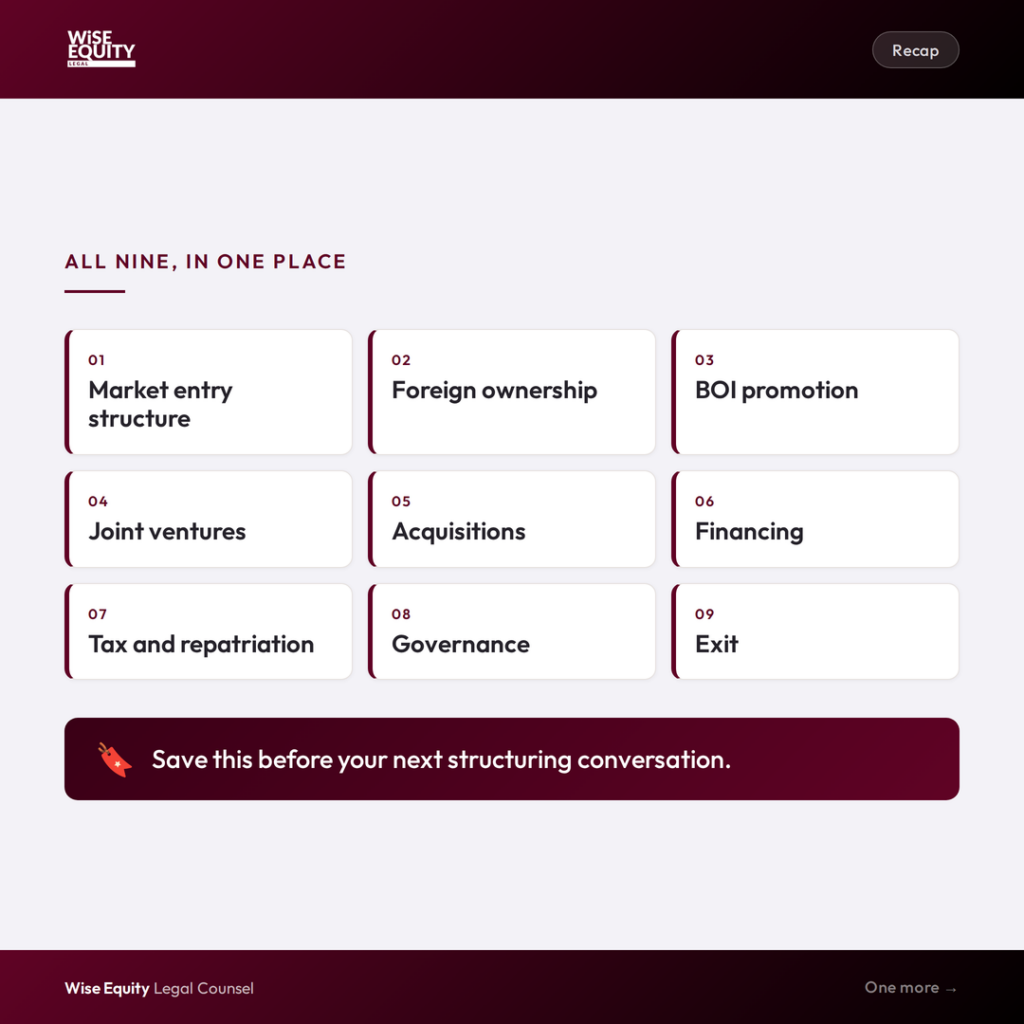

Decision | Why it matters |
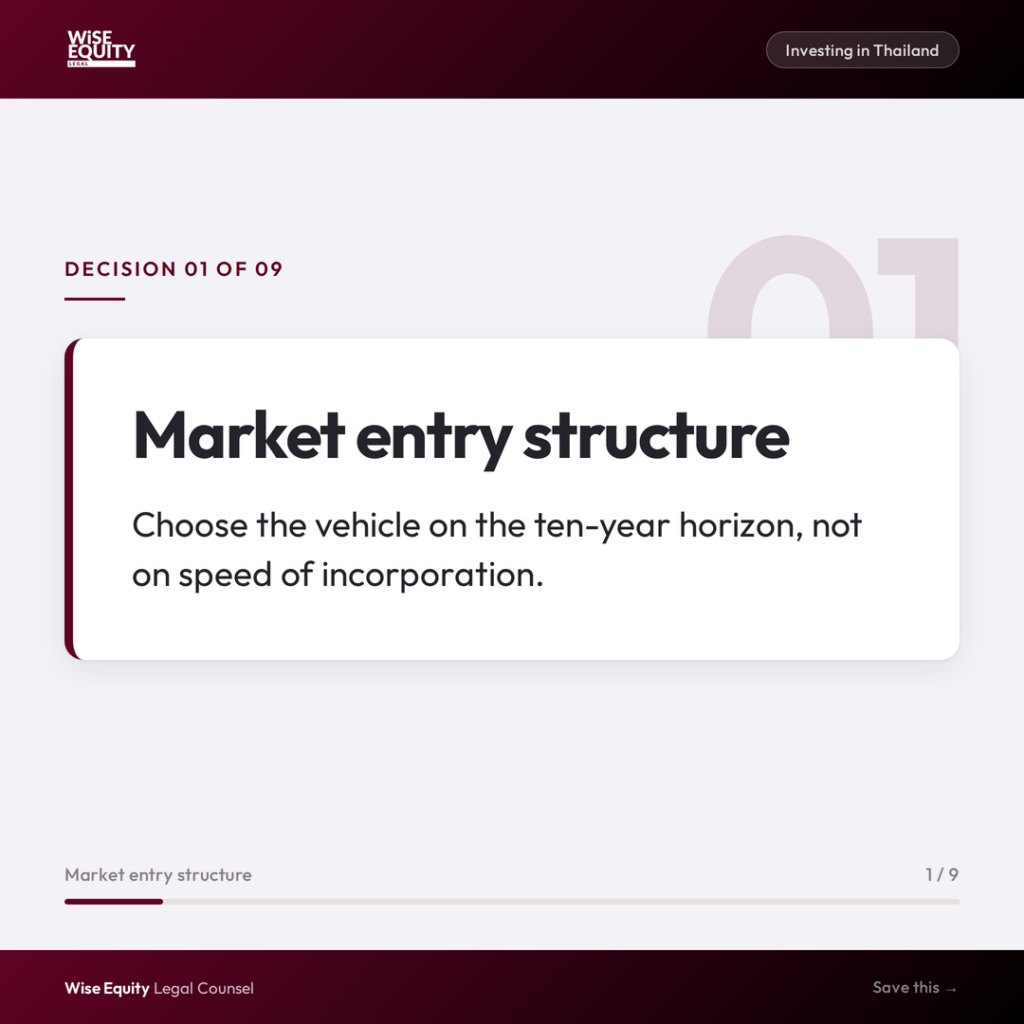
Market entry structure | Choose the vehicle on the ten-year horizon, not on speed of incorporation. |
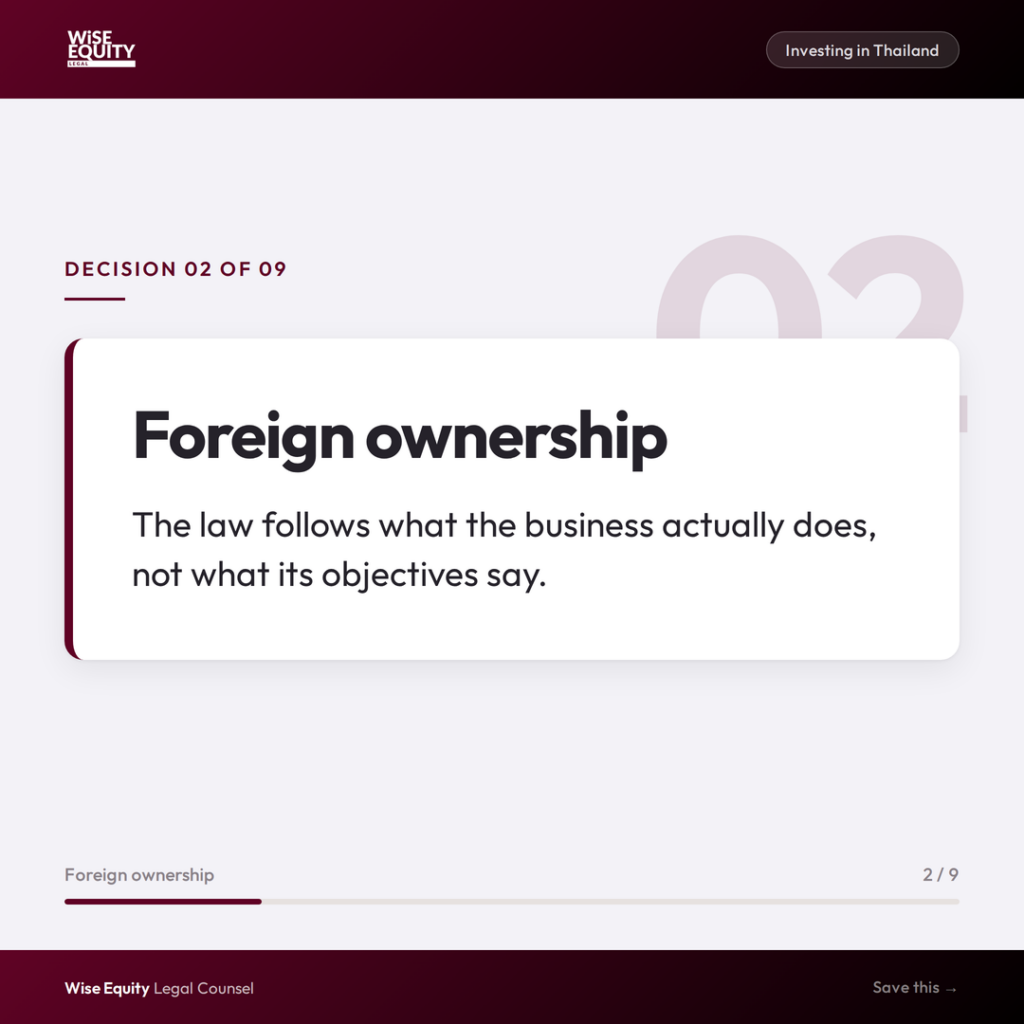
Foreign ownership | The Foreign Business Act follows what the business actually does, not what its objectives say. |
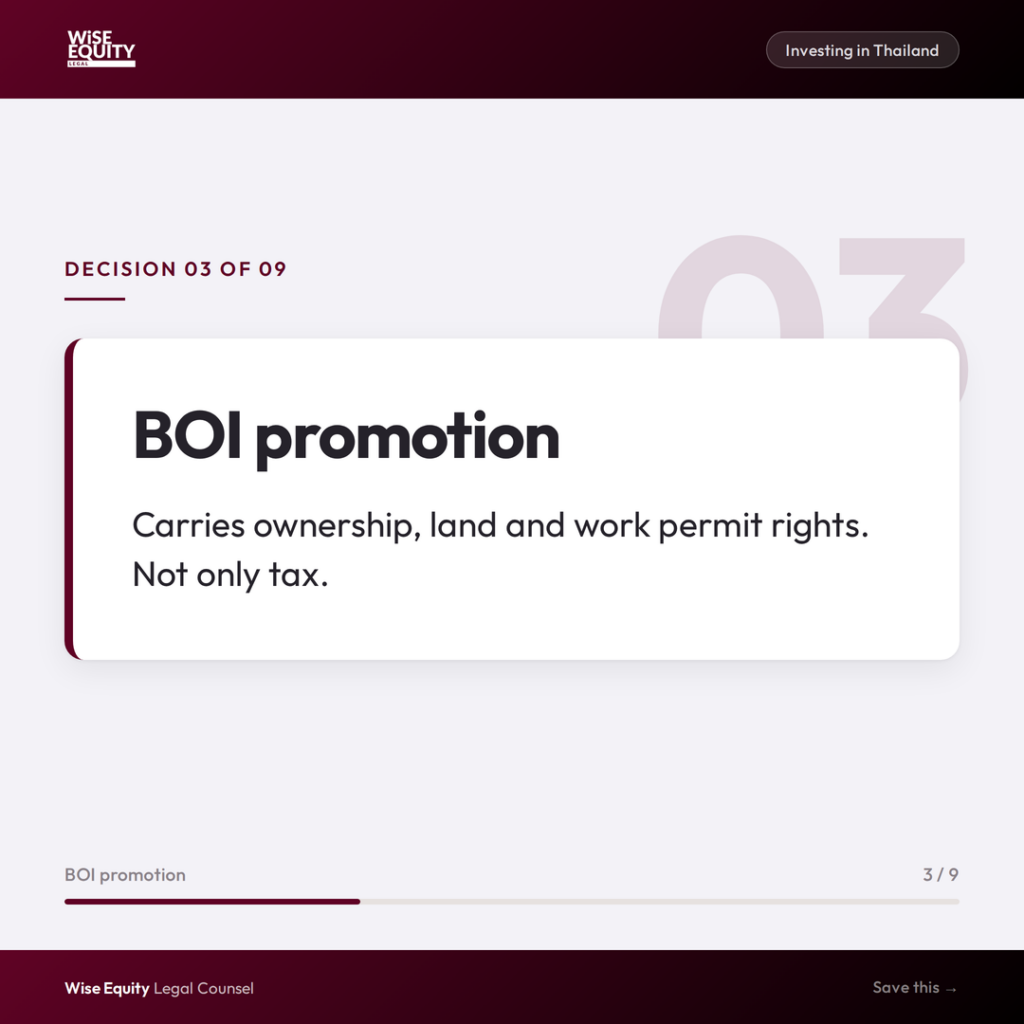
Investment promotion (BOI) | Carries ownership, land and work permit rights — not only tax relief. Assess eligibility before fixing the structure. |
Joint venture governance | Draft the shareholders’ agreement for the day the partners disagree. |
Acquisition structure | Share and asset deals allocate historical liability very differently. |
Financing | The equity and debt mix sets interest deductibility, withholding exposure and future fundraising room. |
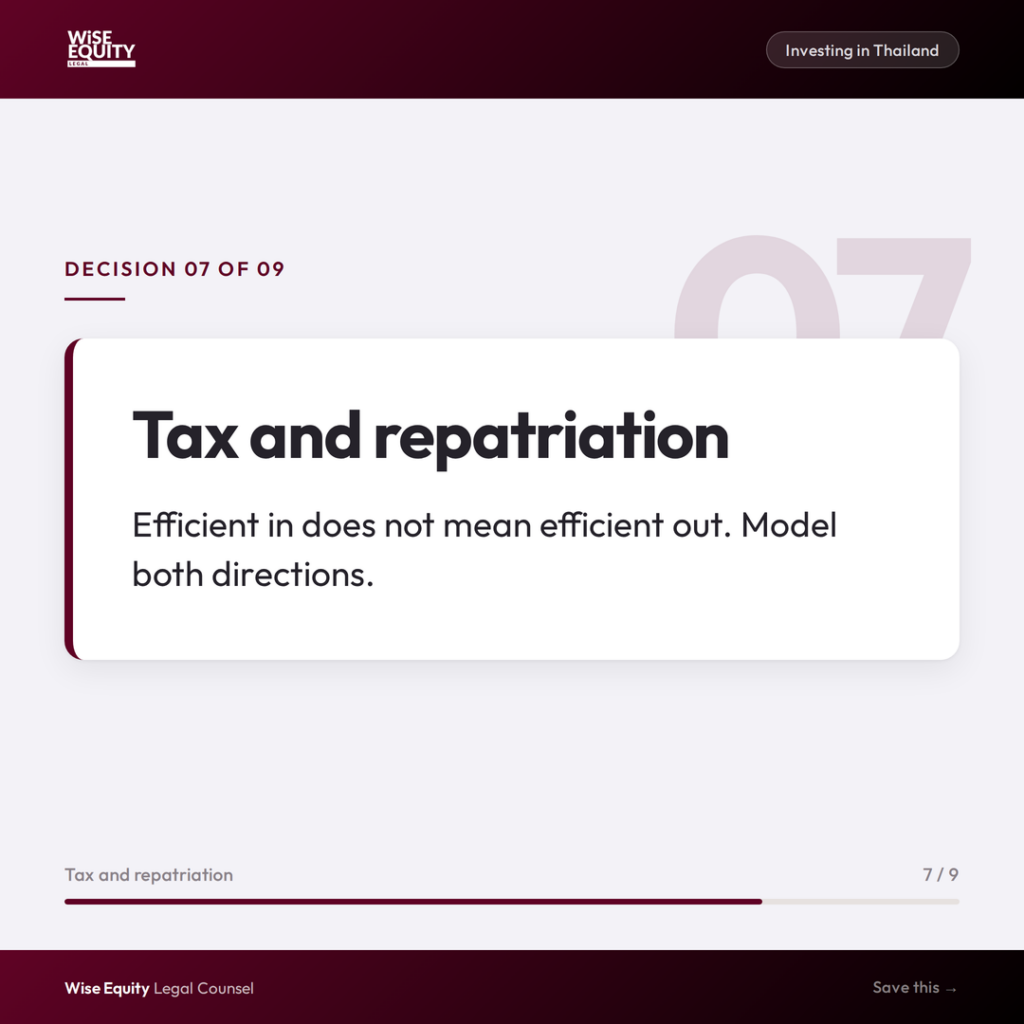
Tax and repatriation | Efficient in does not mean efficient out. Model both directions. |
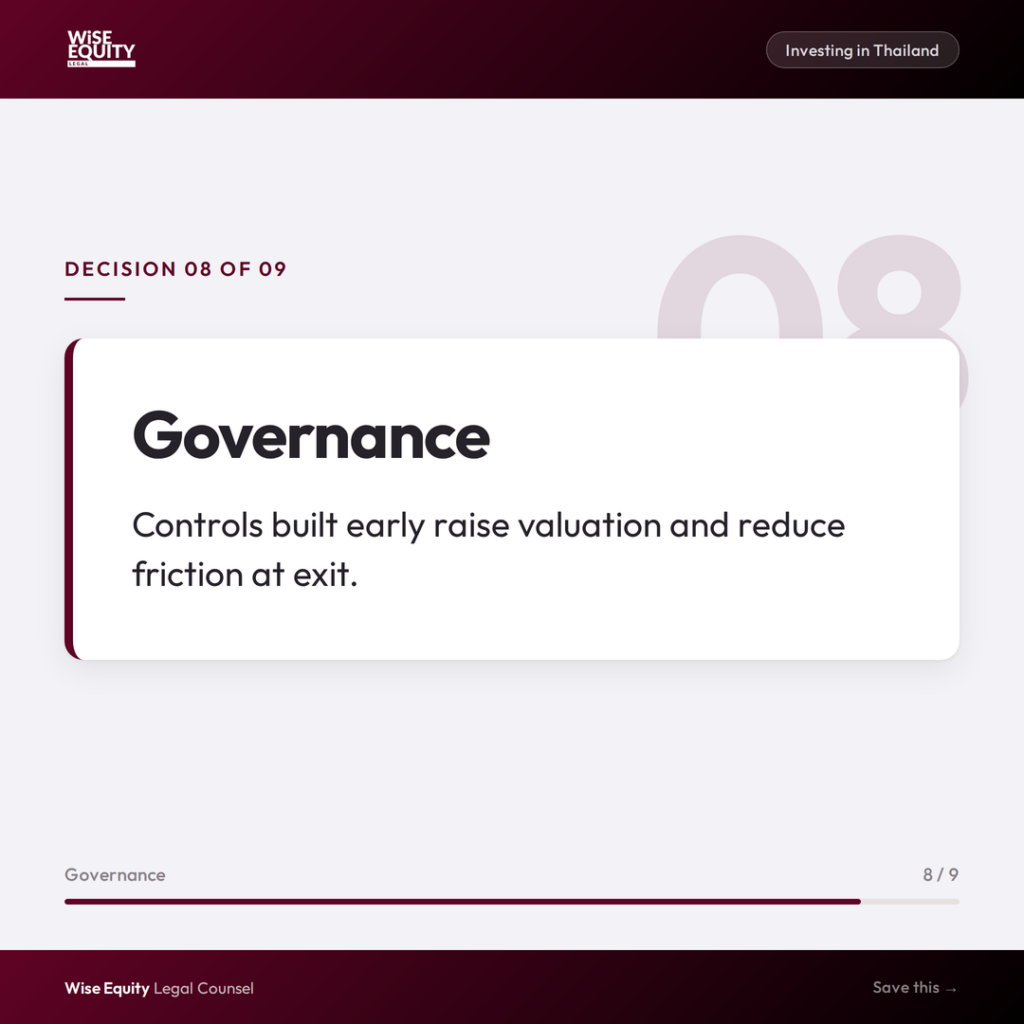
Governance and compliance | Controls established early raise valuation and reduce friction at exit. |
Exit | Agree exit mechanics at entry — that is the only point at which you hold leverage. |
Thailand remains one of Southeast Asia’s most established and strategically positioned destinations for foreign investment. Its central location within ASEAN, developed infrastructure, sophisticated manufacturing base, established capital markets and connectivity with neighbouring economies continue to attract multinational corporations, private equity investors and regional businesses.
At the same time, the Thai investment landscape is evolving. Government policies increasingly encourage investment in technology, advanced manufacturing, electric vehicles, digital businesses, healthcare and other higher-value industries, while regulatory scrutiny of foreign ownership, corporate governance and regulated businesses remains significant.
For investors, therefore, identifying a commercially attractive opportunity is only the beginning. The success of an investment can depend substantially on decisions made before market entry, including the investment vehicle, ownership structure, regulatory pathway, availability of investment incentives, financing arrangements, governance framework and eventual exit strategy.
A successful Thailand investment strategy should consequently be designed around the entire investment lifecycle rather than merely the initial transaction.
Selecting the Right Market Entry Structure
One of the first decisions for a foreign investor is how to establish its presence in Thailand.
Depending on the nature of the proposed business, investors may establish a wholly foreign-owned Thai company, form a joint venture with a Thai strategic partner, acquire an existing Thai business, establish a branch or representative presence, or invest through a structure benefiting from investment promotion.
A Thai private limited company remains one of the most commonly used vehicles. However, the appropriate structure should not be determined solely by ease of incorporation or initial ownership considerations.
Investors should consider the actual business activities to be undertaken, foreign ownership restrictions, licensing requirements, capital requirements, tax implications, financing arrangements, governance rights, repatriation of returns and the anticipated investment horizon.
For acquisitions, an early decision is whether to acquire shares, assets or an entire business. A share acquisition can provide operational continuity because contracts, licenses, employees and assets generally remain with the same legal entity. However, the investor also acquires exposure to the company’s historical liabilities.
An asset or business transfer may provide greater flexibility in determining which assets and liabilities are acquired, although transferring contracts, licenses, employees and assets may require additional consents and procedures.
Transaction structuring should therefore be considered together with legal, tax and financial due diligence rather than as an entirely separate exercise.
Understanding Foreign Ownership Restrictions
Foreign investment in Thailand is principally governed by the Foreign Business Act B.E. 2542 (1999), together with restrictions contained in sector-specific legislation.
Certain activities are prohibited or restricted for foreign investors unless the appropriate permission, exemption or investment promotion is available.
Importantly, the analysis depends on the actual activities conducted by the Thai business. Broad corporate objectives or general descriptions of a company’s operations may not be sufficient to determine whether foreign business restrictions apply.
Foreign investors should therefore conduct a detailed foreign ownership assessment before establishing or acquiring a business in Thailand, particularly where activities involve services, distribution, technology or other restricted sectors.
Structures involving Thai shareholders should also be approached carefully. Nominee arrangements established merely to circumvent foreign ownership restrictions can create significant regulatory and enforcement exposure. Investors should instead consider legitimate alternatives, including obtaining the appropriate foreign business license or certificate, applying for investment promotion, or relying on applicable treaty protections where available.
Certain industries are also supervised by sector-specific regulators. Financial institutions, securities businesses, insurance companies, telecommunications operators and other regulated businesses may be subject to separate foreign ownership, director qualification and licensing requirements.
A change in ownership or control may itself require prior approval or notification. Regulatory analysis should therefore begin at the structuring stage rather than immediately before completion.
Maximising Investment Promotion
Thailand’s Board of Investment (BOI) plays an important role in the country’s strategy for attracting foreign investment.
Qualifying businesses may receive tax and non-tax incentives. Depending on the promoted activity and applicable conditions, these may include corporate income tax incentives, exemptions from, or reductions in, import duties on machinery and raw materials, permission for foreign ownership, rights relating to land ownership for promoted activities and facilitation of visas and work permits for foreign personnel.
Thailand’s investment policy increasingly prioritises businesses capable of enhancing technology, productivity and economic competitiveness. Areas receiving particular attention include advanced manufacturing, electric vehicles and related supply chains, electronics, automation and robotics, digital technology, biotechnology, healthcare and other innovation-oriented industries.
For foreign investors, BOI promotion can therefore serve a purpose extending beyond tax savings. It may fundamentally affect the feasibility and structure of an investment, particularly where foreign ownership, land use or employment of foreign specialists is commercially important.
Potential eligibility should be assessed before the investment structure is finalised. Making significant investments or implementing a structure before evaluating BOI requirements can reduce flexibility and potentially affect the incentives available.
Joint Ventures and Local Strategic Partners
For many foreign investors, partnering with an established Thai business can provide advantages beyond regulatory considerations.
A local partner may contribute distribution channels, market knowledge, customer relationships, licenses, operational capabilities, land, technology or industry connections.
However, the commercial success of a joint venture depends significantly on its governance framework.
The shareholders’ agreement and constitutional documents should clearly address board composition, management authority, reserved matters, voting thresholds, business plans, budgets, funding obligations, dividend policies and restrictions on transfers.
Deadlock mechanisms are particularly important where ownership is evenly divided or both shareholders hold substantial veto rights.
Investors should also address intellectual property ownership, confidentiality, non-compete obligations, related-party transactions and restrictions on competing businesses.
Equally important are exit arrangements. Rights of first refusal or first offer, tag-along and drag-along rights, put and call options, and mechanisms triggered by default or deadlock can materially affect the investor’s ability to realise its investment.
A joint venture agreement should consequently be designed not only for the period when the relationship is successful but also for circumstances where the shareholders’ commercial objectives eventually diverge.
Acquisitions as a Route into Thailand
Acquiring an established Thai business can provide immediate access to customers, employees, licenses, supply chains, distribution networks and local market knowledge.
However, acquisitions require careful due diligence.
The scope should generally include corporate matters, material contracts, financing arrangements, employment, intellectual property, regulatory compliance, litigation, data protection, real estate, environmental matters and sector-specific risks.
Particular attention should be paid to licenses and regulatory approvals where the target operates in a regulated industry. Investors should determine whether licenses remain valid following a change of control and whether the acquisition itself requires regulatory approval.
Transaction documentation should then allocate identified risks appropriately through conditions precedent, representations and warranties, indemnities and other contractual protections.
Post-acquisition integration should also be considered before signing. Management arrangements, governance, employee retention, financing and regulatory reporting can significantly influence whether the anticipated value of an acquisition is ultimately achieved.
For investments in Thai listed companies, additional requirements may arise under securities and takeover regulations, including disclosure obligations, mandatory tender offer requirements, connected transaction rules and rules governing acquisitions or disposals of significant assets.
Financing the Investment
The financing structure is another important element of investment planning.
Investments may be funded through equity, shareholder loans, external debt or a combination of these sources. Each of these methods has different implications for taxation, foreign exchange regulations, interest deductibility, withholding taxes and the future repatriation of funds.
Investors should also consider future capital requirements. A structure that works efficiently for initial market entry may become restrictive if the business later undertakes acquisitions, raises third-party financing or introduces new investors.
Where future fundraising is contemplated, governance, pre-emptive rights, dilution protection and decision-making procedures should be addressed at the outset.
Tax and Repatriation Strategy
Tax considerations should be incorporated into the investment structure before implementation.
Thailand generally imposes corporate income tax on Thai companies, while withholding tax, value-added tax, specific business tax and stamp duty may also apply depending on the nature of the transaction.
International investors should also consider Thailand’s double taxation agreements, transfer pricing rules and requirements applicable to related-party transactions.
The ability to repatriate investment returns is equally important. Returns may be extracted through dividends, interest, service or management fees, capital reductions or proceeds from a future disposal, subject to applicable legal, tax and foreign exchange requirements.
Investors should model both investment and divestment scenarios. A structure that appears efficient when capital is initially deployed may be considerably less efficient when profits or disposal proceeds are eventually repatriated.
Corporate Governance and Regulatory Compliance
Corporate governance is increasingly important for both strategic and financial investors.
Foreign investors should establish appropriate approval authorities, internal controls, compliance procedures and reporting systems from the beginning of the investment.
This is particularly important for businesses that may eventually seek institutional investment, external financing or a listing on the Stock Exchange of Thailand or the Market for Alternative Investment.
Compliance with anti-corruption requirements, competition law, employment regulations, data protection requirements and sector-specific rules should also form part of the investment framework.
Good governance should not be viewed merely as a regulatory requirement. It can enhance the attractiveness and valuation of a business when additional investors are introduced or an exit is pursued.
Planning the Exit at Entry
An effective investment strategy should contemplate the eventual exit from the outset.
Possible exit routes include a trade sale, a sale to another shareholder, a secondary private equity transaction, a corporate restructuring, a capital reduction or an initial public offering.
For joint ventures, contractual exit mechanisms become especially important. Without clearly defined procedures, disagreements over valuation, timing or potential purchasers can substantially delay an exit.
Businesses considering an eventual IPO should begin preparing well before commencing the formal listing process. Ownership structures, related-party transactions, corporate governance, internal controls and regulatory compliance may require significant restructuring if they have not been properly managed from an early stage.
Planning the exit at entry therefore provides investors with greater flexibility and can materially increase the value and marketability of the investment.
Looking Ahead
Thailand continues to offer significant opportunities for international investors seeking access to a substantial domestic market and a strategic base within ASEAN.
However, successful investment increasingly requires a combination of commercial insight and sophisticated legal and regulatory planning.
Foreign ownership restrictions, investment incentives, regulatory approvals, taxation, financing, governance and exit considerations should not be analysed independently. Each can influence the others and ultimately determine whether an investment structure remains effective throughout its lifecycle.
For investors considering Thailand, flexibility is therefore critical. Commercial priorities and regulatory requirements may evolve as the business expands, raises capital, undertakes acquisitions or prepares for an exit.
The strongest investment strategy is not necessarily the structure that provides the simplest route into Thailand. Rather, it is one that allows investors to enter efficiently, operate compliantly, capture available incentives, maintain appropriate control, finance future growth and preserve viable exit options.
With careful planning and an investment structure aligned with both immediate objectives and long-term strategy, Thailand remains a compelling destination for international capital and a valuable platform for broader expansion across Southeast Asia.
———
Discuss Your Thailand Investment Structure
Wise Equity Legal advises international investors on market entry, foreign ownership analysis, BOI promotion, joint ventures, acquisitions, financing and exit planning in Thailand. If you are evaluating an investment — or reviewing a structure established some time ago — we would be glad to discuss it with you.
Yaowarote Klinboon
Executive Partner
yaowarote.k@wiseequitylegal.com
This article is provided for general information only and does not constitute legal advice. Specific advice should be obtained in relation to any particular transaction or structure.

Yaowarote Klinboon